Texas Instruments · 1981
TI-99/4A
Texas Instruments’ improved but commercially unsuccessful home computer.
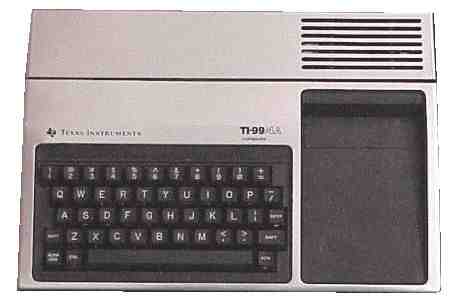
- Released
- June 1981
- CPU
- 16-bit TMS9900 at 3 MHz
- Memory
- 256 bytes of scratchpad RAM and 16K of video RAM; official 32K RAM expansion available
- ROM
- 8K system ROM and 18K GPL GROM
- Text
- 40×24 text mode; 32×24 character-based graphics mode
- Graphics
- TMS9918A/TMS9929A; 256×192 bitmap and 64×48 multicolour modes; 16 colours and 32 sprites
- Sound
- TMS9919 or SN94624: three tone voices and one noise channel
- Storage
- ROM cartridge and cassette; 5.25-inch floppy disk through the Peripheral Expansion System
This was an improved TI-99/4, originally released in 1979, with a simplified internal design, a full-travel keyboard and improved graphics. The 99/4A gained a substantial installed base after steep price cuts, but Texas Instruments lost heavily in the resulting price war and discontinued the machine in 1984.
Performance
The TMS9900 is a 16-bit processor, so the machine might have been expected to be among the fastest home computers available. Only the 8K system ROM and 256 bytes of scratchpad RAM were connected directly to its 16-bit bus, however. Most RAM and support devices, including the video system, were reached through an 8-bit bus.
The machine’s 16K of video RAM was managed by the video display processor and was not directly addressable by the CPU. Programs and data stored there had to be transferred through the video processor, reducing much of the performance advantage of the 16-bit CPU.
Software
Texas Instruments developed Graphics Programming Language, GPL, as a compact 8-bit interpreted language. The original cartridge software used GPL, and the built-in TI BASIC interpreter was itself written in GPL.
TI initially provided little technical information and tried to remain the sole publisher for the system. This discouraged hobbyists and third-party software developers, although the company later released development information and tools. Some machines made from August 1983 also included a lockout chip that prevented the use of unlicensed cartridges.
Technical details checked against Wikipedia’s TI-99/4A article.