Windows on micros are about to become one of the biggest promotional drives since the double glazing boom. The reason? Microsoft Windows is going to be standard equipment on the micros of 23 manufacturers.
MS-Windows was launched in the US two weeks ago (Monitor, Issue 38) and made its first appearance in the UK last week. In the interval it has found further support from hardware and software suppliers, and a roll of companies that will support the product reads like a Who’s Who of micro computing.
IBM’s name isn’t on the roll but that doesn’t deter Microsoft from hailing MS-Windows as an opportunity to create “a standard user interface and development environment”. In other words, what you do with a micro and the way you do it is about to become more consistent across a range of different machines.
MS-Windows is an extension to MS-DOS 2.0 and on the machines of 23 suppliers it will be part of the package. Microsoft UK’s general manager David Fraser expects it to make little or no difference to the cost of the system.
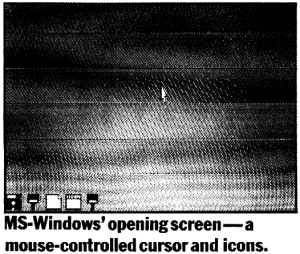
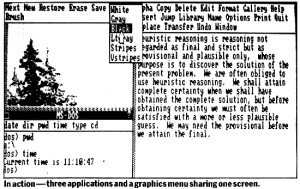
To use it you need 192K of RAM, twin floppies, a bit-mapped display and a mouse. The system lets you select a job from a row of icons, split the screen to accommodate windows featuring several applications, and initiate procedures without touching the keyboard.
For the sake of speed, MS-Windows loads all the selected applications into RAM when it is booted. Data can be transferred between applications, but the system may have restrictions when running jobs requiring a great deal of memory. Microsoft is looking into forms of swapping.
MS-Windows features passive and intelligent windows; a block of text, for example, may be realigned when the window in which it appears is moved to another area of the screen, while a simple display may be clipped as its window shrinks. It also allows overprinting part of a window with a relevant “help” box.
In alphabetical order, MS-Windows’ 23 supporters are: Altos, Apple/Rana, Burroughs, Bytec, Columbia, Compaq, Computer Devices, Convergent Technologies, Data General, DEC, Eagle, Hewlett-Packard, Honeywell, ITT, Mindset, NCR, Polo Microsystems, Seequa, Tandy, Televideo, Texas Instruments, Wang and Zenith.
Software producers supporting the system are Ashton-Tate, Context MBA, Lotus, Peachtree, Software Arts and Software Publishing, and ACT and Micro Focus seem likely to join them.
The first systems with MS-Windows are due out in the US on April 30.
Each manufacturer implements the package, usually by adding two device drivers — an interface to handle the keyboard and mouse input, and another for the screen output.
It may be that Microsoft needs the support of IBM to stand a real chance of establishing a standard with MS-Windows. Mr. Fraser pointed out that IBM doesn’t usually follow suit. It will not pronounce on windows until it is ready to.